

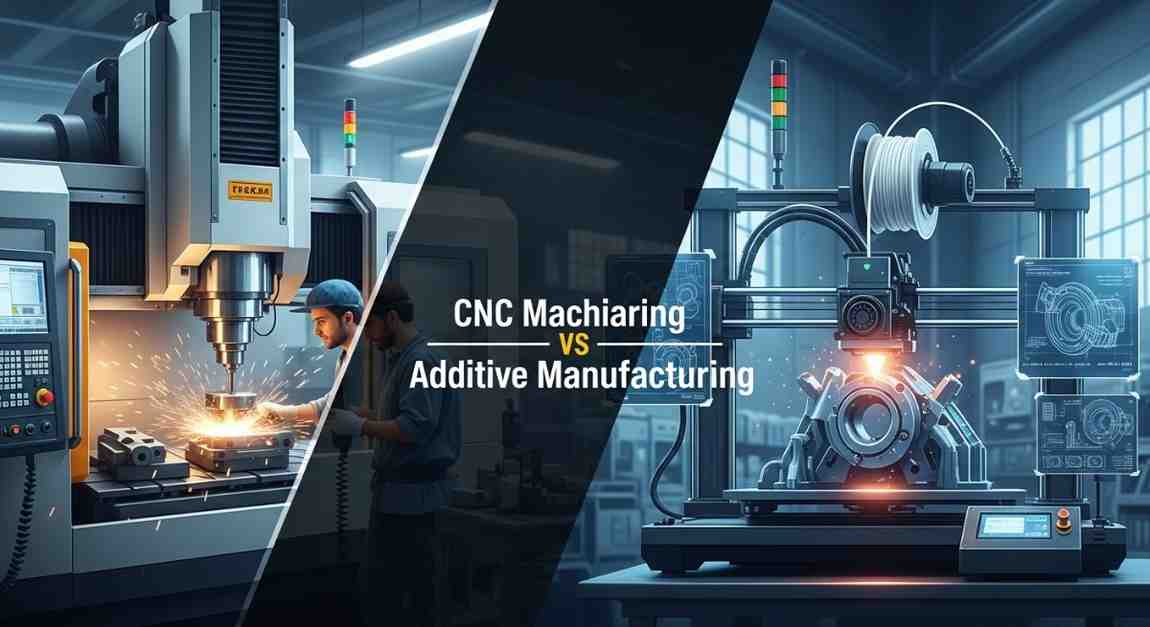
CNC Machining vs Additive Manufacturing: A Practical Guide for Modern Manufacturers
Explore CNC Machining vs Additive Manufacturing in detail. Compare cost, accuracy, materials, speed, and applications to choose the right manufacturing method.
Manufacturers today face more choices than ever when it comes to producing precision components. Among the most discussed options are CNC machining vs additive manufacturing, often framed as traditional manufacturing vs additive manufacturing or CNC machining vs 3D printing.
While both technologies are powerful, they solve very different problems. Understanding when to use subtractive manufacturing versus additive manufacturing can significantly impact cost, lead time, part performance, and long-term scalability.
In this guide, V&S Engineering breaks down the real-world differences between CNC machining vs additive manufacturing, helping engineering, procurement, and operations teams make informed decisions.
Understanding the Core Difference: Subtractive vs Additive Manufacturing
What Is CNC Machining?
CNC machining is a subtractive manufacturing process where material is removed from a solid block using computer-controlled tools.
CNC Machining Process Overview
- CAD model converted to CAM instructions
- Automated machining using CNC milling and turning
- Material removed with high-precision cutting tools
- Final part achieved through controlled subtraction
Common CNC machining capabilities include:
- Precision CNC machining
- 3-axis and 5-axis CNC machining
- Tight CNC machining tolerances
- Superior CNC machining surface finish
Typical CNC machining materials:
- Aluminum
- Steel
- Stainless steel
- Titanium
- Engineering plastics
CNC machining remains the gold standard for high-accuracy, production-grade parts.
What Is Additive Manufacturing?
Additive manufacturing (AM)—commonly known as 3D printing—builds parts layer by layer instead of cutting material away.
Additive Manufacturing Process Overview
- CAD model sliced into layers
- Material deposited or fused layer-by-layer
- Minimal material waste
- Complex geometry manufacturing without tooling
Key additive manufacturing technologies include:
- Metal additive manufacturing (SLM, DMLS, Binder Jetting)
- Polymer additive manufacturing (FDM, SLS, SLA)
- Industrial 3D printing systems
AM is widely used for rapid prototyping with 3D printing and low-volume production 3D printing.
CNC Machining vs Additive Manufacturing: Side-by-Side Comparison
| Factor | CNC Machining | Additive Manufacturing |
| Manufacturing Method | Subtractive manufacturing | Layer-by-layer manufacturing |
| Accuracy | Very high | Moderate to good |
| Surface Finish | Excellent | Often requires post-processing |
| Material Range | Broad, production-grade | Expanding but limited |
| Geometry Complexity | Moderate | Excellent |
| Volume Scalability | Ideal for high-volume CNC production | Best for low-volume |
| Tooling | Required | No tooling |
| Waste | Higher material removal | Minimal waste |
| Lead Time | Fast once programmed | Fast for prototypes |
Accuracy, Strength & Performance Comparison
Dimensional Accuracy Comparison
- CNC machining tolerances can reach ±0.005 mm or better
- Additive manufacturing tolerances vary by technology and often require secondary machining
Part Strength Comparison
- CNC-machined parts maintain ca onsistent grain structure
- AM parts may exhibit anisotropic strength depending on build orientation
For load-bearing, safety-critical components, CNC machining often delivers superior structural reliability.
Cost, Speed & Manufacturing Efficiency
CNC Machining Cost vs 3D Printing Cost
CNC machining cost factors:
- Material removal rate
- Machine time
- Tool wear
- Setup complexity
Additive manufacturing cost analysis includes:
- Machine amortization
- Powder or filament cost
- Build time
- Post-processing requirements
Manufacturing Lead Time Comparison
- Rapid prototyping vs traditional manufacturing: AM wins for early-stage design
- CNC excels once designs are finalised and volumes increase
Production Scalability
- CNC machining scales efficiently for repeat production
- Additive manufacturing remains slower for large batch sizes
Design Considerations: DFM vs DfAM
Design for Manufacturability (DFM)
Optimised for CNC machining:
- Standard features
- Consistent wall thickness
- Tool accessibility
Design for Additive Manufacturing (DfAM)
Optimised for AM:
- Complex part geometries
- Lightweight part design
- Structural optimisation through lattice structures
Understanding these design principles prevents unnecessary redesigns and cost overruns.
Industry Applications: Where Each Method Excels
CNC Machining Applications
- Aerospace manufacturing methods
- Automotive manufacturing technologies
- Medical device manufacturing
- Tooling and fixtures manufacturing
- Production-grade custom part manufacturing
Additive Manufacturing Applications
- Prototype vs production parts
- On-demand manufacturing
- Complex internal channels
- Low-volume specialty components
Sustainability & Material Efficiency
Manufacturing Waste Comparison
- CNC machining produces more scrap
- Additive manufacturing uses only rethe quired material
Energy Consumption in Manufacturing
- CNC machines consume consistent power over long cycles
- AM machines have lower waste but higher per-part energy usage
Sustainable Manufacturing Methods
- Metal powder reuse improves AM efficiency
- CNC scrap can often be recycled
Sustainability depends more on application strategy than technology alone.
How V&S Engineering Approaches CNC vs AM Decisions
At V&S Engineering, we evaluate:
- Functional requirements
- Material performance needs
- Production volume goals
- Cost vs lifecycle value
Our strength lies in precision CNC machining, but we also understand when additive manufacturing adds value—especially during prototyping or design validation stages.
Frequently Asked Questions (FAQ)
1. Is CNC machining better than additive manufacturing?
Neither is universally better. CNC machining excels in precision, strength, and scalability, while additive manufacturing is ideal for rapid prototyping and complex geometries.
2. Can 3D printing replace CNC machining?
For production parts, CNC machining remains essential. AM often complements CNC rather than replacing it.
3. Which is more cost-effective: CNC machining or 3D printing?
For low volumes and prototypes, AM is often cheaper. For high-volume production, CNC machining is usually more economical.
4. Which method offers better tolerances?
CNC machining delivers superior dimensional accuracy and surface finish compared to most additive processes.
5. Can CNC machining and additive manufacturing be combined?
Yes. Many manufacturers use AM for prototyping and CNC machining for final production parts.
Final Verdict: CNC Machining vs Additive Manufacturing
Choosing between CNC Machining vs Additive Manufacturing is not about trends—it’s about application fit.
- Choose CNC machining for precision, durability, and scalable production
- Choose additive manufacturing for rapid prototyping, design freedom, and low-volume runs
For manufacturers focused on performance, consistency, and long-term value, CNC machining remains a cornerstone of modern industrial production.
V&S Engineering brings deep expertise in precision CNC machining, helping clients move confidently from concept to production—using the right manufacturing method at the right time.