
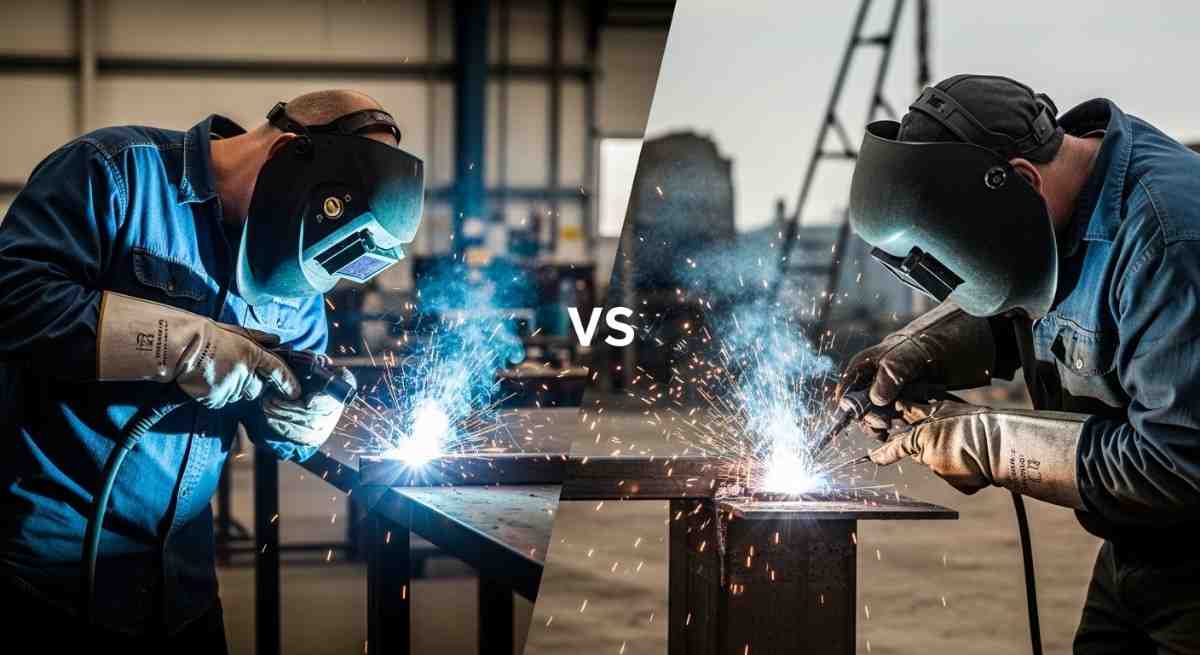
MIG vs Stick Welding
MIG vs Stick Welding explained in depth. Compare cost, efficiency, applications, pros & cons, and discover the best welding method for industrial, automotive, and construction projects worldwide.
Choosing the right welding method can directly impact project cost, structural integrity, production speed, and long-term durability. Among all arc welding processes, MIG welding (Metal Inert Gas welding) and Stick welding (SMAW – Shielded Metal Arc Welding) remain the most widely used techniques across construction, automotive fabrication, heavy machinery, shipbuilding, and industrial manufacturing.
For welding contractors, manufacturers, and buyers searching for industrial welding solutions, understanding the difference between MIG welding and stick welding is critical. Each process has unique strengths, limitations, and ideal use cases—especially when considering metal thickness, working environment, budget, and skill level.
This in-depth guide explores MIG vs Stick welding from a technical, commercial, and practical standpoint, helping decision-makers select the best welding method for performance, efficiency, and ROI.
What Is MIG Welding (Metal Inert Gas Welding)?
MIG welding, also known as Gas Metal Arc Welding (GMAW), uses a continuously fed wire electrode and a shielding gas (typically argon, CO₂, or a gas mix) to protect the weld pool from atmospheric contamination.
How MIG Welding Works
A motorized wire feed delivers filler metal continuously
An electric arc forms between the wire and the base metal
Shielding gas prevents oxidation and porosity
Creates clean, consistent welds with minimal slag
Common MIG Welding Gases
Argon (for aluminum and thin metals)
CO₂ (cost-effective for steel)
Argon/CO₂ mixes (industrial fabrication)
Key Applications of MIG Welding
Automotive fabrication
Custom welding solutions
Sheet metal work
Manufacturing and production lines
Robotic and automated welding systems
What Is Stick Welding (SMAW / Shielded Metal Arc Welding)?
Stick welding, formally known as SMAW, uses a flux-coated consumable electrode. The flux creates a shielding gas and slag layer when burned, eliminating the need for external gas.
How Stick Welding Works
The electrode is manually fed into the weld
Flux coating melts and shields the weld
Slag forms and must be chipped off
Extremely tolerant of rust, dirt, and wind
Common Stick Welding Electrodes
E6010 (deep penetration)
E6013 (general purpose)
E7018 (structural steel welding)
Typical Stick Welding Applications
Structural steel welding
Outdoor welding projects
Heavy machinery repair
Pipeline and construction welding
Emergency and field repairs
MIG vs Stick Welding Comparison (Side-by-Side Overview)
Ease of Use
MIG welding is widely considered the best welding method for beginners
Stick welding requires greater hand-eye coordination and experience
Weld Quality
MIG delivers cleaner, more aesthetically pleasing welds
Stick welds are strong but produce slag and spatter
Working Environment
MIG welding performs best indoors
Stick welding excels outdoors and in harsh conditions
Speed and Productivity
MIG welding is significantly faster
Stick welding is slower but more versatile
Pros and Cons of MIG Welding
Advantages of MIG Welding
High welding speed and efficiency
Minimal cleanup and spatter
Easy to automate and scale
Ideal for thin to medium-thickness metals
Excellent for production and fabrication shops
Disadvantages of MIG Welding
Requires shielding gas
Less effective in windy environments
Higher equipment cost
Limited penetration on very thick metals
Pros and Cons of Stick Welding
Advantages of Stick Welding
Works on dirty, rusty, or painted metals
Ideal for thick metals and structural steel
No external gas required
Extremely portable
Lower initial equipment cost
Disadvantages of Stick Welding
Slower welding process
More slag cleanup
Steeper learning curve
Harder to achieve cosmetic welds
MIG vs Stick Welding for Thick Metals
When welding thick steel or structural components, stick welding’s advantages become clear:
Deep penetration electrodes
Strong mechanical bonds
Excellent for load-bearing structures
MIG welding can handle thick metals with proper settings, but typically requires:
Multi-pass welding
Higher amperage machines
Advanced technique
Verdict: Stick welding often wins for structural steel and heavy machinery welding.
MIG vs Stick Welding for Automotive Fabrication
Automotive work demands:
Precision
Clean welds
Thin metal compatibility
MIG welding advantages dominate in automotive fabrication:
Smooth weld beads
Less warping
Faster production
Verdict: MIG welding is the preferred method for automotive fabrication and custom car builds.
Outdoor Projects: MIG vs Stick Welding
Wind disrupts shielding gas, making MIG welding unreliable outdoors.
Stick welding:
Generates its own shielding
Works in rain, wind, and dust
Ideal for construction sites
Verdict: Stick welding is superior for outdoor welding projects.
Cost Comparison: MIG vs Stick Welding
Equipment Costs
MIG welding machines: Higher upfront cost
Stick welding machines: Budget-friendly
Operating Costs
MIG: Gas, wire, consumables
Stick: Electrodes only
Long-Term ROI
MIG welding offers higher productivity
Stick welding offers lower maintenance
Cost comparison of MIG vs stick welding depends on project scale and frequency.
MIG Welding Machines vs Stick Welding Machines
MIG Welding Machines
Ideal for workshops
Available in single-phase and industrial 3-phase
Compatible with automation
Common in welding equipment for sale catalogs
Stick Welding Machines
Lightweight and portable
Reliable for field use
Favored by mobile welding contractors
Industrial Welding Solutions: Which Method Should You Choose?
Choose MIG welding services if you need:
High-volume production
Clean, precise welds
Automotive or manufacturing work
Choose Stick welding services if you need:
Structural steel welding
Outdoor or remote work
Heavy machinery repair
Many welding contractors in the USA, Canada, Germany, and Japan offer custom welding solutions that combine both techniques for optimal results.
Welding Safety Tips (Essential for Both Methods)
Use proper welding safety gear
Wear auto-darkening helmets
Ensure ventilation
Use fire-resistant clothing
Follow welding joint types and metal thickness guides
FAQs
1. Which welding method is better: MIG or stick?
It depends on the application. MIG is better for clean, indoor fabrication, while stick welding excels outdoors and on thick metals.
2. Is MIG welding easier than stick welding?
Yes. MIG welding is widely considered the best welding method for beginners due to its simplicity and control.
3. Can MIG welding be used for structural steel?
Yes, but stick welding is often preferred for structural steel due to deeper penetration and strength.
4. Which welding method is cheaper?
Stick welding has lower upfront costs, but MIG welding can be more cost-effective long-term due to higher productivity.
5. Is MIG welding good for outdoor projects?
Not ideal. Wind disrupts shielding gas, making stick welding the better choice outdoors.
6. What industries use MIG welding the most?
Automotive fabrication, manufacturing, custom welding solutions, and production welding.
7. What is the best welding machine for workshop use?
MIG welding machines are typically best for workshops due to speed, cleanliness, and versatility.
Conclusion
There is no universal “best” welding method—only the right method for the job.
MIG welding excels in speed, precision, and clean results
Stick welding dominates in durability, portability, and harsh environments
For manufacturers, contractors, and buyers seeking industrial welding solutions, the smartest approach is often to use both techniques strategically.
If you’re looking for professional MIG welding services, stick welding services, or welding equipment for sale, working with an experienced welding contractor ensures quality, compliance, and long-term reliability.