

What Are Metalloids?
What are metalloids? Learn the definition, properties, examples, uses, and importance of metalloids in semiconductors, electronics, and modern technology.
Metalloids are a unique group of elements that quietly power many of today’s most advanced technologies. Positioned between metals and nonmetals on the periodic table, these elements combine the strengths of both categories, making them indispensable in industries such as electronics, semiconductors, renewable energy, and advanced materials manufacturing. From microchips and solar cells to communication systems and precision engineering, metalloids play a crucial role in shaping modern innovation.
In this guide, we break down what metalloids are, explore their defining physical and chemical properties, examine real-world examples and uses, and explain why they are so important in global markets, including the USA, Canada, Germany, and Japan. Whether you are a student, researcher, procurement professional, or technology buyer, this introduction to metalloids provides the clarity and insight needed to make informed decisions with confidence.
Metalloids
Metalloids, also known as semimetals, are chemical elements that exhibit properties of both metals and nonmetals. They are unique because they do not fully behave like either group, making them extremely valuable in electronics, semiconductor manufacturing, and advanced materials.
Key Characteristics of Metalloids
Intermediate behavior between metals and nonmetals
Moderate electrical conductivity
Often brittle solids
Can act as conductors or insulators depending on conditions
This dual nature is why metalloids are essential in high-performance electronic applications.
What Are Metalloids in the Periodic Table
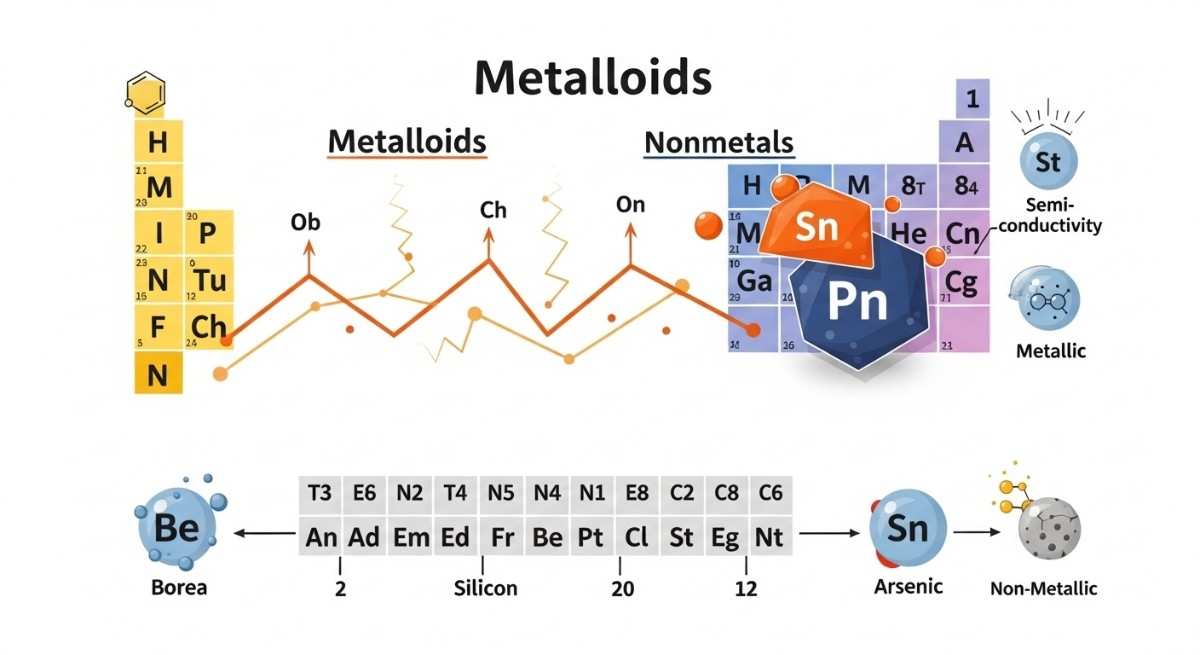
Metalloids are located along the zig-zag line that separates metals and nonmetals on the periodic table. This positioning visually represents their hybrid chemical and physical behavior.
How Many Metalloids Are in the Periodic Table?
There are six to seven commonly accepted metalloids, depending on the classification criteria used in chemistry and materials science.
List of Metalloids (Metalloids Elements List)
Commonly Accepted Metalloids
| Element | Symbol |
|---|---|
| Boron | B |
| Silicon | Si |
| Germanium | Ge |
| Arsenic | As |
| Antimony | Sb |
| Tellurium | Te |
Some classifications also include polonium due to its borderline behavior.
Physical Properties of Metalloids
Understanding the physical properties of metalloids is essential for their industrial and technological applications.
Key Physical Properties
Solid at room temperature
Brittle, not malleable like metals
Metallic luster in some cases
Semiconducting electrical conductivity
These properties make metalloids ideal for electronics, solar panels, and microchips.
Chemical Properties of Metalloids
The chemical properties of metalloids further distinguish them from pure metals and nonmetals.
Key Chemical Properties
Can form both acidic and basic oxides
React differently depending on the bonding environment
Often form covalent compounds
Show variable oxidation states
This versatility allows metalloids to be used across chemical manufacturing and advanced material synthesis.
Metalloids vs Metals vs Nonmetals
Comparison Table
| Property | Metals | Metalloids | Nonmetals |
|---|---|---|---|
| Electrical Conductivity | High | Moderate | Low |
| Brittleness | Low | High | High |
| Appearance | Shiny | Semi-shiny | Dull |
| Industrial Use | Structural | Electronics | Chemical |
Metalloids bridge the gap, making them indispensable in applications where controlled conductivity is required.
Uses of Metalloids in Technology and Industry
Metalloids and Semiconductors
Metalloids are the backbone of the semiconductor industry, especially silicon and germanium.
Major Industrial Uses
Semiconductor chips and microprocessors
Solar cells and photovoltaic panels
Fiber-optic communication systems
Flame retardants and specialty alloys
Medical and chemical research
Metalloids in Everyday Products
Smartphones and computers
Electric vehicles
Renewable energy systems
Advanced sensors and automation equipment
Importance of Metalloids in Modern Technology
The importance of metalloids continues to grow as industries demand:
Faster electronics
Energy-efficient devices
High-performance materials
Metalloids enable innovation in electronics, clean energy, and advanced manufacturing, making them strategically important for global markets including North America, Europe, and Asia.
Metalloids Classification Explained
Metalloids are classified based on:
Electrical behavior (semiconductors)
Position on the periodic table
Chemical reactivity
This classification helps manufacturers and buyers select the right material for specific applications.
FAQs
What elements are metalloids?
Boron, silicon, germanium, arsenic, antimony, and tellurium are the most widely recognized metalloids.
Why are metalloids important in electronics?
Metalloids have controlled conductivity, making them ideal for semiconductors, microchips, and integrated circuits.
What is the difference between metalloids and nonmetals?
Metalloids have both metallic and nonmetallic properties, while nonmetals lack electrical conductivity and metallic behavior.
Are metalloids used in everyday technology?
Yes. Metalloids are found in smartphones, computers, solar panels, vehicles, and communication systems.
Where are metalloids located on the periodic table?
They are located along the zig-zag line separating metals and nonmetals.
Conclusion
Metalloids are essential elements powering modern technology, electronics, and industrial innovation. Their unique combination of physical and chemical properties makes them indispensable for semiconductors, renewable energy, and advanced materials.
If you are a buyer, supplier, or technology-driven business, understanding metalloids can help you:
Choose the right materials
Improve product performance
Stay competitive in global markets
Explore high-quality metalloid materials or request expert guidance today to support your next innovation.