

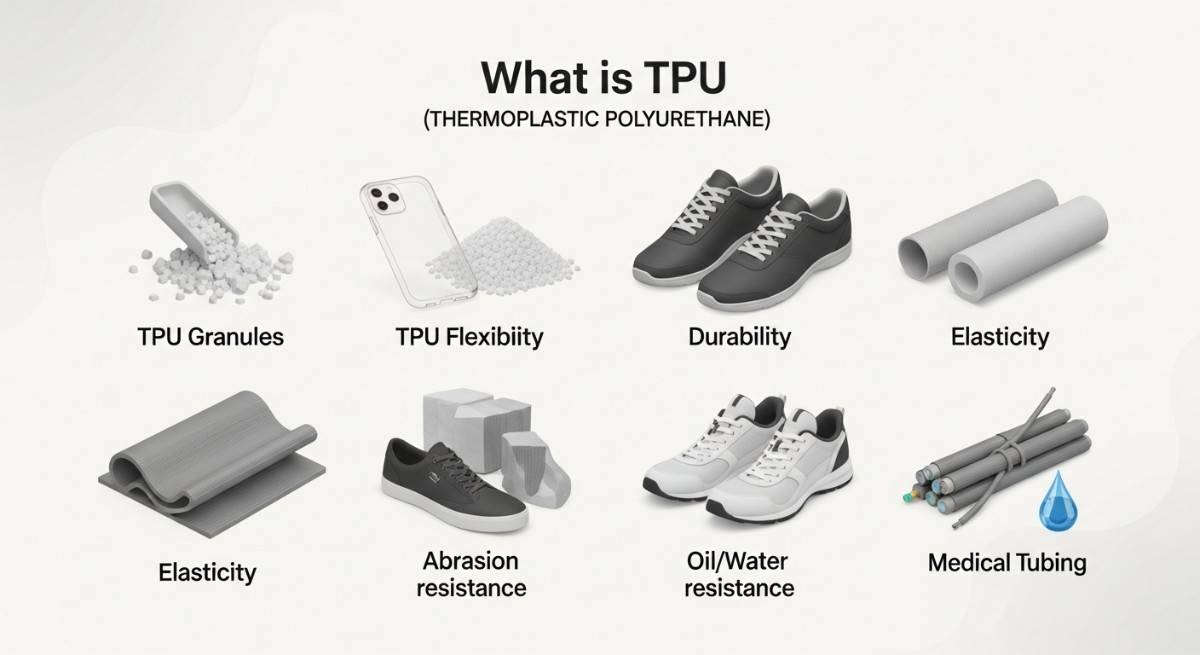
What is TPU material?
What is TPU material? Learn the meaning, properties, advantages, disadvantages, uses, and comparisons of Thermoplastic Polyurethane (TPU) for industrial and commercial applications.
TPU material, also known as Thermoplastic Polyurethane, is one of the most versatile and high-performance polymers used in modern manufacturing. It is widely adopted across industries such as automotive, electronics, medical devices, footwear, sportswear, cables, and industrial equipment due to its exceptional balance of flexibility, strength, durability, and chemical resistance.
As global manufacturers increasingly demand materials that can withstand mechanical stress, environmental exposure, and long service life, TPU plastic has emerged as a preferred alternative to traditional rubber, PVC, and other flexible plastics.
This guide explains what TPU material is, its properties, benefits, limitations, applications, processing methods, and how it compares to other materials—helping buyers and decision-makers choose the right material for their products.
TPU Material
TPU Meaning and TPU Full Form
TPU stands for Thermoplastic Polyurethane. It is a type of thermoplastic elastomer (TPE) that combines:
The elasticity and softness of rubber
The strength, durability, and processability of plastic
Unlike traditional rubber, TPU can be melted, reshaped, and recycled without losing performance, making it highly efficient for industrial production.
What Is Thermoplastic Polyurethane (TPU)?
Thermoplastic Polyurethane is a polyurethane-based polymer formed by reacting diisocyanates with polyols and chain extenders. This creates a segmented molecular structure consisting of:
Soft segments – provide flexibility and elasticity
Hard segments – deliver mechanical strength and abrasion resistance
This structure allows the TPU polymer to perform reliably under repeated stress, impact, bending, and exposure to chemicals.
TPU Material Properties Explained
Key Characteristics of TPU Plastic
TPU material properties make it suitable for both demanding industrial environments and consumer-facing products.
Mechanical Properties
Highly flexible plastic with rubber-like elasticity
Excellent abrasion-resistant material
Strong impact resistance
High wear resistance
Good tensile, tear, and fatigue strength
Chemical and Environmental Properties
Chemical-resistant plastic (oils, fuels, greases, solvents)
Moderate heat-resistant polymer (typically -40°C to 120°C)
Resistant to UV, ozone, and weathering (formulation dependent)
Certain grades offer hydrolysis and microbial resistance
Physical Properties
Available in soft TPU and hard TPU
Can be transparent TPU or colored TPU
Lightweight yet extremely durable
Smooth, high-quality surface finish
Is TPU a Good Material?
Yes. TPU is considered a premium engineering material for applications requiring durability, flexibility, and long-term performance.
Benefits of TPU Material
Combines rubber-like flexibility with plastic strength
Long service life under mechanical stress
Excellent resistance to abrasion and impact
Wide hardness range for design flexibility
Recyclable and reprocessable
Suitable for complex shapes and precision parts
TPU Material Disadvantages
Higher cost compared to PVC or basic plastics
Lower heat resistance than silicone
Requires controlled processing conditions
TPU Uses and Applications Across Industries
TPU Applications by Industry
Consumer Electronics
TPU in phone cases
Protective covers and housings
Flexible connectors and seals
Footwear and Sportswear
TPU in footwear soles and midsoles
TPU in sportswear logos and flexible components
High-performance films and laminates
Automotive Industry
TPU in automotive parts
Wire and cable jacketing
Air ducts, seals, and vibration dampers
Medical Devices
TPU in medical devices
Catheters and medical tubing
Wearable healthcare products
Industrial and Electrical
TPU in cables
Hoses, belts, rollers
Protective sheets and films
TPU vs Other Materials: Material Comparison Guide
TPU vs Silicone
TPU offers better abrasion and wear resistance
Silicone provides higher temperature resistance
TPU is stronger; silicone is softer and more chemically inert
TPU vs PVC
TPU is more flexible and durable
PVC is lower cost but less elastic
TPU performs better in cold environments
TPU vs TPE
TPU provides higher mechanical strength
TPE is softer but less durable
TPU suits for demanding industrial applications
TPU vs Rubber
TPU is recyclable and easier to process
Rubber requires vulcanization
TPU offers superior chemical resistance
TPU vs Nylon
TPU is flexible; nylon is rigid
TPU has better impact resistance
Nylon handles higher continuous temperatures
TPU Manufacturing and Processing Methods
TPU Injection Molding
Used for high-volume production of precision components with consistent quality.
TPU Extrusion
Ideal for producing tubing, hoses, films, and cable jackets.
TPU Sheets and Films
Widely used for protective layers, waterproof membranes, and industrial covers.
TPU 3D Printing
Flexible TPU filaments allow rapid prototyping and customized part production.
TPU Grades and Types
TPU materials are available in various grades to meet specific performance requirements:
Soft TPU – maximum flexibility and comfort
Hard TPU – increased rigidity and load-bearing strength
Flexible TPU – balanced mechanical properties
Transparent TPU – aesthetic and optical uses
Colored TPU – branding and design customization
FAQ’s
What is TPU material?
TPU is a thermoplastic polyurethane elastomer that combines rubber-like flexibility with plastic strength.
Is TPU plastic or rubber?
TPU is a thermoplastic elastomer—it behaves like rubber but processes like plastic.
Is TPU better than silicone?
TPU is better for abrasion resistance and durability, while silicone excels in heat resistance.
Is TPU waterproof?
TPU is water-resistant and commonly used in waterproof films and protective coatings.
What are the disadvantages of TPU?
Higher cost, moderate heat resistance, and precise processing requirements.
Is TPU suitable for medical applications?
Yes, medical-grade TPU is widely used in tubing, catheters, and wearable devices.
Conclusion
TPU material is a high-performance polymer that delivers exceptional flexibility, strength, and durability across a wide range of applications. Its ability to replace rubber, PVC, and other plastics while offering superior performance makes it a preferred choice for manufacturers worldwide.
For businesses seeking a flexible, durable, and chemically resistant material that performs consistently in demanding environments, Thermoplastic Polyurethane provides an excellent balance of performance and process efficiency.